Monday, June 6, 2016

The Acropolis of Styra

We keep driving by this sign, just outside the village of Styra, but we don't know what it means. 


When I finally look it up I discover Drakospita is the Greek word for Dragon House. I find an old guidebook on the bookshelf in our living room and it says:

"Some of the most interesting sights of Southern Evia are the famous Drakospita, or dragons' houses, peculiar ancient buildings of special architecture, which, according to some, were temples of Hera. Drakospita are houses built by dragons. Because of the material used for their construction, but even more so on account of the amazing way in which they are built, there was but one explanation for our naive ancestors: they must have been erected by supernatural forces. There are many such structures in Southern Evia, which indicate that centuries before our written history began there must have been men who were indeed 'dragons'. 'Dragons', most likely, not on account of their physical strength but because of the force of their minds and their ability to devise edifices, which, even in our age of architectural and technological advancements, still astonish and bewilder. The dragon houses of Southern Evia, some of which are in excellent condition even today, were built by men who lived on the island before the 7th century BC and used them as temples or dwellings."

The island where Gary and I are house-sitting for the next six weeks appears to be the dragon house capital of the world.

Every time we pass the blue metal sign I feel the urge to turn, but we do not, until our younger son, Jason, arrives for a visit. And then early one bright December morning, the three of us go out searching for a house built by dragons.

We almost miss the turnoff, but a sharp right takes us onto a paved road heading uphill. The houses on either side are soon left behind, and the asphalt turns to dirt and gravel. We are heading away from civilization, towards rolling green hills studded with white stones and boulders. There are small structures and enclosures for sheep tucked here and there along the way. Our path is dusty and rocky and potholed, and sometimes we have to slow way down so the car doesn't bottom out, and sometimes someone has to get out and move big rocks out of the way. But it's a pretty nice road. For back country Greece. There are signs and arrows showing us the way, and when we reach the end there's even a parking lot. We get out and see a path with a red arrow painted on a rock. We follow the arrow and find more arrows and dots that lead us through low thorny bushes and under flowering trees. In a few minutes we come to a clearing and see a red bull's eye. Drakospita!

We walk over and under and around prehistoric structures made of gigantic gray slabs of rock. There are arches and small doorways and stone fences. The roofs are partly covered in grass and have big spaces in the middle where something seems to be missing. There are things that look like water basins, and others that could be altars. We ask questions out loud. But everything is unknowable. We hope nothing falls on our heads.


We're glad we've seen a dragon house, but we're not completely filled. There's room for more. So we head back down the road. I remember seeing a small sign with the word castle on it pointing in a different direction.

We find the sign at a fork in the road and go right this time, instead of left.


We have no idea where we're going or what we'll find. When the road runs out, we park. Our car is the only one in sight. Ahead of us is a mountain with what looks like a pile of rocks on top. We all laugh and say it's probably just a natural formation that someone thought looked like a castle. We see a path and decide to follow it. 


Rocks are everywhere. It looks like boulders have rolled down from the top of the mountain. All the plants are scrubby and prickly and close to the ground. There are little purple flowers clinging to the rocky soil, and bright orange balls hanging from bushes. The colors are the colors of fall. There are more red painted arrows and dots, some are old and faded, and some look brand new. The path zigzags back and forth, and keeps getting steeper and steeper. We get out of breath. Or at least some of us do.


When we look up, the pile of rocks starts to look different. It starts to look constructed. 


We hear bells and see sheep grazing. We reach a rock that has two words written on it. I can't read the first one, but I understand the second one. It feels like the painter is proud of us for making it this far, and is telling us we're almost there. 


A few minutes later we are standing on top of the mountain,
face to face with a stonehenge portal to another world.


There is no one here but us. The wind is blowing and the sun is shining. The sky is blue. Puffy white clouds float by. The only sounds are sheep sounds. We step through the doorway.

The grass is short and green and perfectly cropped. All around us white rocks are strewn and stacked, some shaped into natural benches. The views are extraordinary. Never ending. Stretching in all directions. 


To the west we can see the ferry leaving Nea Styra, heading across the water towards Agia Marina. A little farther south we see the village of Styra, a place so ancient that Homer wrote in the Iliad that its people took part in the campaign against Troy. We know it as the place to buy cheap wine in plastic bottles, and emergency supplies when the stores in Nea Styra are closed for siesta.

There are no ropes or barriers or informational plaques. No gift shops or ticket booths or guards. No warnings, no restrictions, no rules. Nothing is blocked off, and no one is watching. The red painted arrows have disappeared.


The three of us scatter in different directions.
I notice a baby blue cross painted on the side of a giant rock and head towards it. 


I go around the corner and it looks like a dead-end, but I find a way to keep going. There's a ledge, and a drop off, and I feel afraid. I sit down paralyzed, hug the wall, and wait. It looks too scary to keep going, and when I look back it looks too hard to climb back up. I call out, but no one can hear me. In a little while I hear my son calling mom above my head. He doesn't hear me when I answer, so I get brave and crawl back up the way I came.

Gary appears with a story about a cave carved in the side of the mountain, with an altar and a Greek flag inside. And then he disappears again. Jason and I walk past cliffs, and over boulders, and startle a herd of sheep. A black ram seems to be in charge. He eyes us suspiciously, and makes us laugh as he herds his harem quickly away. The animals vanish over the hill, leaving the echo of their bells. We see Gary a long way off waving and yelling to us. He has seen the roof of a church.


We navigate through piles of sheep poop and make our way over to him. Someone has built a church here on the top of this mountain. It is small and whitewashed and gleaming in the sun. 


The door is unlocked, so we go inside. Plaster is falling off the walls. Everything is faded and flyspecked. There are candles and crosses, and incense burners on the walls. There's a stack of plastic stools in the corner, and a large gilded frame on a stand with a date on the bottom that says 2015. Jason has disappeared.


When we come out of the church we hear Jason calling, you have to come up here, it really is a castle. And then we finally see it. We find impossible arches and walls of stacked stones. We see what might have been a well, and enclosures for animals, and steps leading down into unknown places. 


When I look out and see the ferry leaving Nea Styra for a second time, I realize we have been here, at what we later learn is the Acropolis of Styra, for hours.

I see Jason far away, standing on enormous blocks of stone. I am thinking about sacrifices and gods and blood and superstition. About history and castles and the age of the world. About this deserted place so filled with the presence of humans.


Once upon a time we went looking for a dragon house, and accidentally found the Acropolis of Styra. We climbed to the top of an ancient mountain and looked out at Homer's world. The sky was blue, the sun was shining, and we could see forever. My husband was walking on one side of me, and my son was walking on the other, and all of us were laughing.



Sunday, February 21, 2016

The Book of Names


"There was no problem with the killing or the burning of the corpses,
the problem was with the things they brought."

We are in the fourth hour of our six hour study tour of Auschwitz-Birkenau. Our guide is speaking to us. She is quoting from the memoirs of an officer that worked at the camp. Our group is standing huddled around her, shivering in the cold wind, trying to hear. She is speaking softly. We are in the camp they call Auschwitz II - Birkenau, and for some reason, no one is using headsets here. Sometimes her voice trails off, as if it's hard for her to say the things that must be said. Or maybe she's just tired. We hear a train whistle in the distance. Big black crows fly overhead. There is mud on our shoes.

We are standing in the place where the people stepped out from the railroad cars and were told to go either left or right. Our guide is getting ready to show us where the buildings used to be that stored all the things the prisoners brought with them; things that would eventually be sorted and sent back to Germany. She is getting ready to show us where the killing and the burning took place. She keeps saying, the pregnant women were all immediately killed.


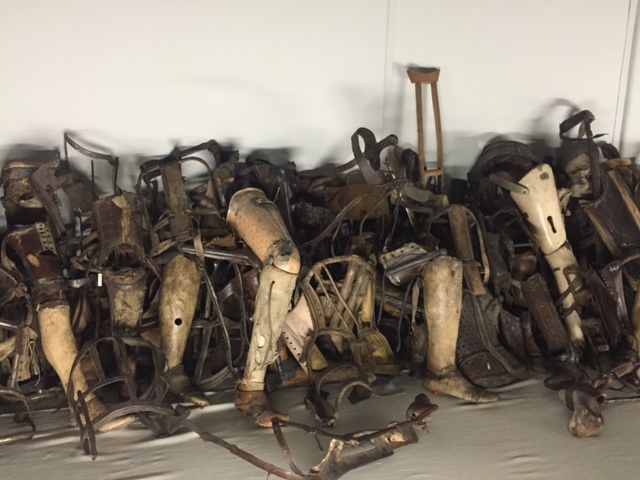
I am thinking of the piles we saw earlier in the day. Giant piles behind glass. Suitcases and combs and shaving brushes. Wooden legs and glasses and prayer shawls. I am thinking of the deep colorful pile of coffee pots and pans and bowls and cups. And of the shoes. The fancy shoes and the plain shoes. The sandals and the high heels. Green shoes black shoes red shoes. Men's shoes. Women's shoes. Children's shoes.


* * * * * * * * *

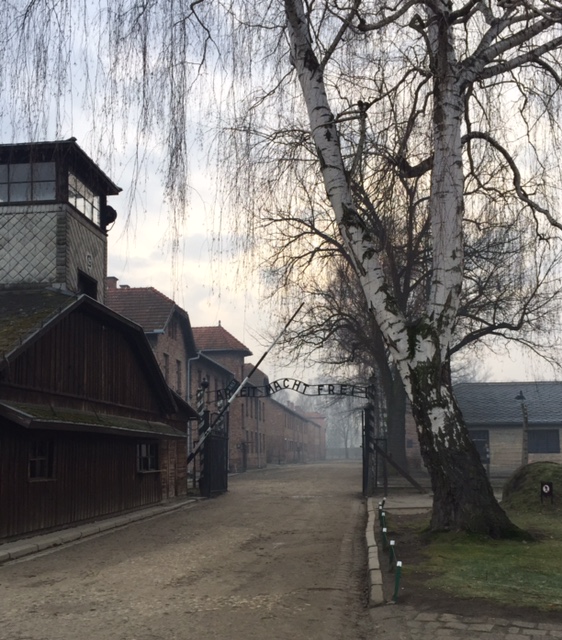
Our "educator" rounds us up at 9 am, makes sure we all have working headsets, and herds us out into the courtyard. We are in Auschwitz I - the original camp. As she begins to speak it begins to rain. No one seems to notice. We walk through a gate under metal words. Arbeit Macht Frei or Work Sets You Free. Everyone is hushed and obedient. We crunch down gravel roads between rows and rows of numbered brick barracks. Dark clumps of people are walking quietly around us with their own "educators."

We go in one building where we see a hallway covered with hundreds of photos of faces, all in identical frames. In the beginning, every prisoner was photographed. The date of their arrival was noted, and the date of their death. I look in the eyes of the people on the wall. I see fear and despair, terror and disbelief. I see questions. Defiance. Some of them have faint smiles. Some of them look as if they have hope. I wonder who all these human beings were before they were an exhibit in a hall. I see that most of the women were dead within a few weeks or at most months of their arrival. The men seemed to survive a little longer. After a while no one took pictures of the prisoners when they arrived, or marked down in a book the day they died.

We weave in and out of the old brick buildings. Up and down stairs. There are displays on the walls, and things to see in glass cases. There is too much information to read. We walk past rough wooden beds, and straw mattresses on the floor. We file in and out of rooms. Here are long troughs for washing. There is the execution wall. There is the prison where the first gassing experiments took place. Here are empty canisters of Zyclon-B.


We go upstairs to a dim room where there is a pile that is impossible to comprehend. It fills up all the space behind a wall of glass. It is a mountain made out of uncountable clumps of cut off human hair. There are pictures on the wall of enormous bags filled with it that were found at the end of the war. Bags that were ready to be shipped to Germany, where their contents would be made into cloth. There is a bolt of fabric on display of the final product. Our guide explains what we are seeing. Sometimes her words fall away at the end of her sentences. When she is finished speaking she gives us time to be alone.

The last thing we see are the showers and the ovens. The place they figured out how to do the exterminating before they moved the whole operation to the newer, bigger camp down the road. Everything is small. Bricks and metal and cement. It is hard to breathe.


And then the morning is finished.

People eat sandwiches.
And wait for the bus to Auschwitz II - Birkenau.


There are no sidewalks or gravel or cement around the buildings here. We are walking in mud filled with the footprints of all the other people that have come this way. The trees are winter trees. The cold rain comes and goes. There are chimneys poking up everywhere, showing where the wooden barracks used to be. The camp is a city. We cannot see the end of it. Stacks of red bricks disappear into the distance. Barbed wire fences close everything in.


We are brought to the children's barracks, where the Russian children with blonde hair and blue eyes were housed, waiting to be "Germanized." It's dark inside and hard to see. There are faded nursery rhyme pictures on the walls that were painted by adult prisoners. The wooden bunks are shorter than the adult ones we have seen. There are ladders to climb to the top. There is cold gray January light coming in the windows. The smell is old wood. Dried up roses are scattered here and there.

And here are the death barracks, where you were brought if you were ill, or injured, or unable to work. Where you were given no food or water and were left to die, and if you didn't die quickly enough you were gassed. And here is the building with the simple sign that reads: Inside this building Nazis killed mothers and their newborn babies with shots to the heart.

There are flags and wreaths and plaques and memorials.
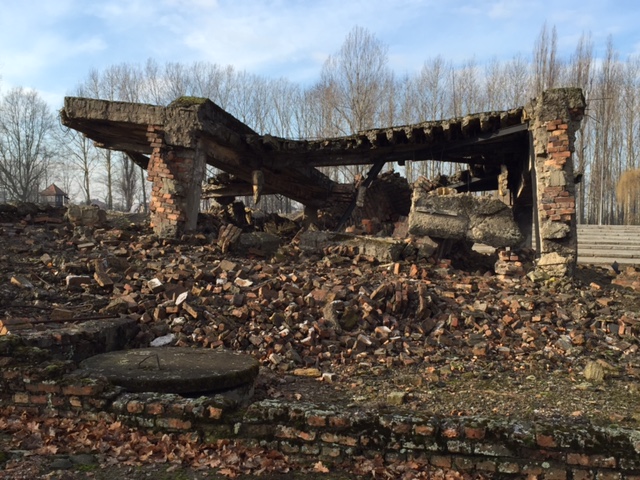
The gas chambers and crematoriums are exploded piles of rubble.


And then the quiet telling is over for the day.

Everyone gets back on the bus. We go home to warm bright rooms. A good dinner. A soft bed.
Our guide's gentle voice whispers in my head.

The next day we feel compelled to return without a guide. We are the first ones through the gate. The camp is deserted. There is mist hanging in the air. A man on a ladder is changing lightbulbs. A woman comes out of a building with cleaning supplies. We retrace some of our steps of the day before. Our footsteps echo in the empty buildings.


Our final stop is Block 27. The Shoah display. We step inside. The haunting music with the Hebrew words echoes all around us. We find the walls with the penciled children's drawings, half erased. Their silenced voices are so deafening I run from the room. We find the Book of Names; a massive monolith that fills the world. We search out names of family and friends. When I unexpectedly find my husband's Chinese surname there I reach out and run my fingers across the page. The printing is slightly raised. I touch the names over and over. The oil from many hands has turned the edges of the book gray.


* * * * * * * * *

Our guide told us that sometimes in the summer she does 2 six hour study tours in one day. Which makes me wonder about this pretty woman with the soft voice who speaks English with a Polish accent. Makes me wonder why, and how, she does this difficult thing over and over and over. I think about darkness, and all the things that are not darkness. And then I think about my sister. The one who came to visit us last summer. The one who swam in the pool every day, when the sun was out. And I am remembering my sister, and how every time she got in that pool she would start rescuing all the little creatures that had fallen in the water. The bees and the butterflies. The creatures that were not water creatures. The ones that were drowning. About how she would cup them gently in her hands, take them out of the pool, and put them on the cement to dry. About how she would get out of the water herself, to sit in the sun, and would worry about all the tiny living things that were going to die because she wasn't there to save them. How she would sigh and say, it's such a big responsibility. And how later, when the sun had gone away, and we were sitting with our wine, she would talk about the crickets and the beetles and all the other insects she had rescued that day, and how sad she felt when she couldn't save a certain bumblebee. How she took it out of the water, and kept moving it away from the puddles, about how it lifted up its leg, and maybe fluttered its wing, but died anyway. And even though the bumblebee died, somehow I am sustained.


Tuesday, December 29, 2015

The King of Delenia

On a remote and windswept and tumbling down pile of rocks, on a large and lonely island in the ancient world of Greece, there is a magical realm known as Delenia, and it is ruled by a king. The King of Delenia is a noble and beautiful and well-mannered dog that was rescued from the dog catchers in Athens some years ago, and brought to this place to reign, forever and always, until the end of his days. I do not know how a dog can be caught by dogcatchers five times, and live to tell the tale, much less escape, and become sovereign to a magical kingdom on the edge of the sea, but such is the legend of Public, His Royal Highness, the King of Delenia.


Having spent, admittedly, only a very little time observing the customs in this part of the world, I still find myself able to imagine those Greek dog catchers taking a small siesta from their canine catching activities, sprawling on rickety metal chairs, or standing in dark clumps in doorways, smoking, talking loudly, gesticulating wildly, the caught dogs cowering somewhere nearby. I imagine Public escaping somehow, again and again, the noisy men so distracted by their cigarettes and their conversations that they fail to see what is happening right in front of them.

I don't really know what happened. I know that Panagiotis, the chess playing self-taught carpenter, lawyer and political activist, a man once considered to be one of the most dangerous civilians in the country, founding member of Greenpeace Greece, and dreamer upper of Delenia, somehow saved this handsome dog with the Egyptian eyes, and brought him here. I know Panagiotis died suddenly several years ago. I know that Public has been under the care of house-sitters, and caretakers, and assorted ragged and random people passing in and out of his kingdom ever since.

I know that Public is damaged. He does not like Greek men. He does not like sudden movements towards him, or small confined spaces. He keeps his tail tucked in tight between his hind legs. When we arrive his belly is covered in red sores from the sharp edges of the Pampas grass that he loves to make nests in, but he won't allow anyone to examine his sores, or put ointment on them. He will not let you help him, and if you try he will run away, and remember for a little while to stay away from you. And maybe this is why I fall so quickly and easily in love with him. Because he doesn't ask for anything. Because he is proud and quiet and polite, and lives and survives on his own terms. And also of course because I want to save him.

After we are left in charge of Public we start to go for walks. I have no idea if walking with people is a thing that he has done before. There is no one here to tell me. The first few times I have to coax him with cheese. But once he realizes where we are going and what we are doing his tail comes out from between his legs. He prances. His steps become jaunty and his mouth opens in a smile and he runs ahead fast, and then stops to wait for the humans. Pretty soon he starts to recognize the English words let's go for a walk, and pretty soon we are climbing the steep driveway nearly every day, exploring the rutted roads and rocky hillsides of his wild and isolated realm.


We find little stone huts everywhere. Some are visible from the road
and some are tucked away, hidden in among tangled thorny masses of overgrown vegetation.


Sometimes we follow the main road up to a tiny village,
where we go to the well to fill up our big plastic jugs with drinking water. 


Sometimes we walk down to the edge of the sea. 


Sometimes Public takes off in another direction, running around fences, bounding over great green expanses of grass, disappearing for a little while, off on his own adventure. But most often he stays close, a little ahead, or a little behind. When it's time to go home Public often has a better idea, he'll start out in another direction, stop, look at us, and wait. Let's go down this road he seems to be saying, or up this hill, or over here. But if we just keep heading back he is soon trotting along beside us.

We work on fattening Public up. We feed him kibble mixed with cans of chunky wet gravy-filled dog food, and rice and lentils, and fresh eggs from the chickens in the coop by the driveway. By the time we leave Delenia his sores have healed, the bones on his hips are not protruding quite as much, his coat is softer and his stomach rounder. The better to survive the winter here.

Because it is cold at night in Greece in December. And Public's bed is outside. He trembles a lot out there. Sometimes it's hard to tell if he is trembling from the temperature, or his memories. I came upon him once shivering so badly that his teeth were chattering. But still he will not come inside. Every night we try and entice him in to the warmth, to the light, to our company. We coo to him and hold out food. We say ella, the Greek word for come. And every night there is the dance at the door. He wants to come in, but the parts of him that are damaged won't let him. When he finally wins the battle and walks inside it is always slowly, with his head down. He steps gingerly across the floor as if it might explode, glancing back at the door to make sure it's still open. When he takes whatever it is we are offering he does so gently, and then quickly turns and escapes. The first week it takes hours for him to tiptoe in and take the food we are holding out. But as the weeks go by the ritual speeds up, and on a few rare nights towards the end of our six week stay he comes in and sits down a while, and then lies down, and then closes his eyes.


There are two thunderstorms while we are at Delenia, and when the lightning and thunder start up Public comes in without a bribe, comes inside and stays, quivering at my feet until it is quiet outside. There is also one memorable night when he comes in by himself without the help of a storm, and lies at our feet the entire evening, and when we get up to go to bed he follows us into the bedroom, and stays there all night on his cushion at the foot of our bed. And when we wake up in the morning he is still there, breathing his deep sleep breathing, and it feels like we have saved him, at least a little bit, at least for one night.


Sometimes, if it isn't too cold, we just sit together on the steps and stare out at the sea. 


Everywhere the sea. And I cannot help where my mind goes when all that water is there in front of me. The water they call the Aegean Sea. The one where the trembling frightened tired refugees climb in the boats that may or may not make it to the other side. The ones that wrap up their babies in warm clothes and hold them tight and just step in. And some of them reach dry land and some of them do not. My arm is around Public as we look out, and when I feel the tears I do not know if they are for the noble King of Delenia, patiently waiting for someone to come and stay with him forever and always, and feed him eggs and cheese, and walk with him in the hills of his kingdom, and rub his belly until he snores, or if they are for the cold hungry wet scared children that the world doesn't want, and tries not to see. Or how to tell the difference.

And when Public comes inside that night and eats what we have held out to him, and stays for a while in the warmth and the light, resting on the cushion at our feet, I think that I do not know what could be more holy in all this wide and confusing and sometimes despairing world, than to invite a damaged soul inside with the offer of some food and a warm safe place to lie their body down.


* * * * * * * * * * * * * * * * * * * * * * * * * * * * * * * * * * * * * * * * * * * * * * * * * * * * * *
Panagiotis, 
dreamer upper and builder of Delenia, 
rescuer of Public, 
playing chess at the place he dreamed up and built, 
on a large and lonely island, 
in the ancient country of Greece.